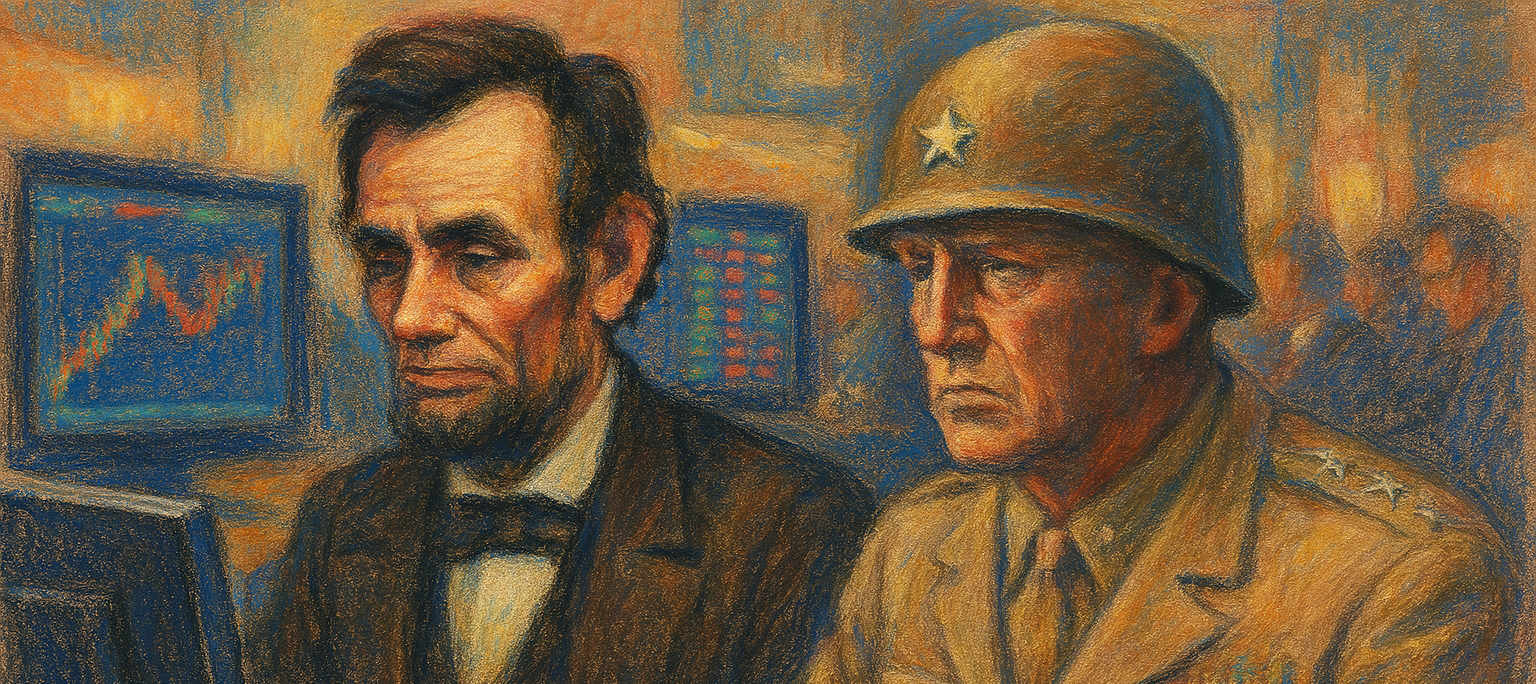
Abraham Lincoln and General George S. Patton would approach the stock market with radically different temperaments — but together, they’d form a trading duo built on moral clarity and tactical aggression.
Abraham Lincoln
Abraham Lincoln would trade with deliberation and principle. He’d study the long arc of history, seeking companies that reflect enduring values and structural integrity. His trades would be grounded in macro conviction — infrastructure, agriculture, energy — sectors that shape the national character. He’d favor long-term positions, using options conservatively to hedge risk rather than chase reward. Lincoln’s edge would come from his ability to see the moral and economic consequences of policy shifts, and to act with quiet resolve when others panic. He’d be the kind of trader who journals every decision, not just for performance, but for posterity.
The best way to destroy an enemy is to make him a friend.
Abraham Lincoln
General George S. Patton
Patton, by contrast, would trade like a field commander in motion. He’d thrive in volatility, attacking momentum setups with precision and speed. Patton wouldn’t wait for consensus — he’d front-run sentiment, using aggressive call spreads and tactical put protection to exploit chaos. His portfolio would be kinetic: defense stocks, energy plays, commodities, and volatility instruments. He’d treat the market like a battlefield, where hesitation is defeat and conviction must be backed by action. Patton would study tape like terrain, scanning for weakness and striking with force. His edge would be discipline under fire — knowing when to press and when to pivot.
If everyone is thinking alike, then somebody isn’t thinking.
General George S. Patton
A good plan violently executed now is better than a perfect plan executed next week.
Summary
Together, Lincoln and Patton would balance vision and velocity. Lincoln would anchor the portfolio with structural plays and moral clarity; Patton would drive tactical gains and exploit short-term dislocations. One would trade the soul of the market, the other its pulse. And in moments of crisis — when fear surges and volatility spikes — they’d be the rare duo that combines calm foresight with decisive execution.
In a Tweet
Lincoln brings the vision, Patton brings the velocity — the soul and the pulse of the market. One anchors with clarity, the other strikes with force. Together, they’d be calm foresight fused with decisive execution.