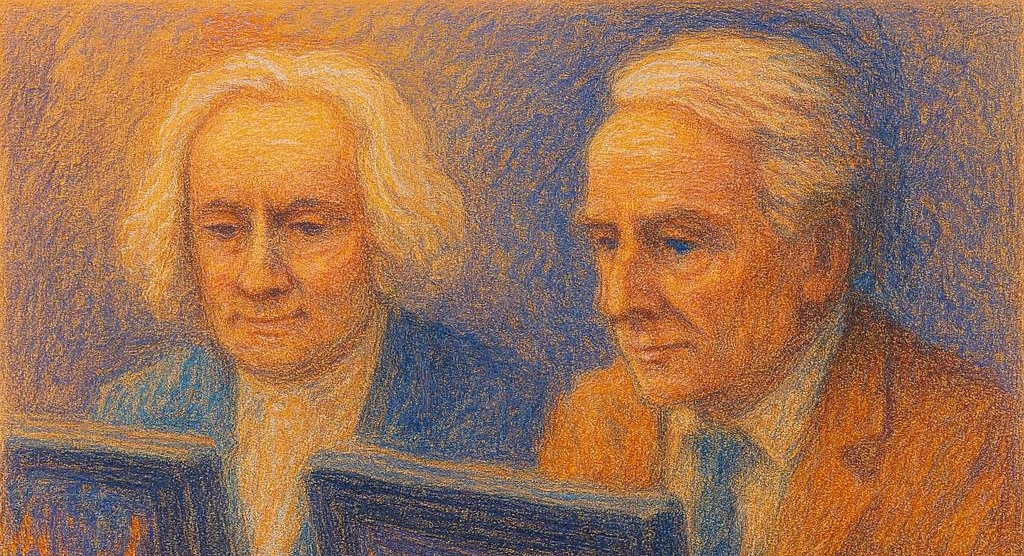
A trader’s blend of Emerson’s Prudence and Newton’s Third Law settles into one clean principle: see clearly, act deliberately, and know the market will answer whatever you do. Prudence teaches you to read the surface without distortion — the subtle shifts in liquidity, the change in tone, the imbalance forming before the crowd wakes up. Newton adds the reminder that every move you make draws a counter‑move, so your edge comes from acting in ways that anticipate the pushback instead of being blindsided by it.
Together they shape a discipline of grounded perception and intentional pressure — no chasing, no forcing, just aligning with what the tape is already offering and pressing only where the structure thins. That’s the fusion: clarity before action, action with awareness, and awareness of the reaction that always follows.
Isaac Newton
Isaac Newton would trade the market like a physicist who refuses to be fooled by noise. He’d anchor every decision to forces, momentum, and equilibrium, treating price as an object in motion that continues its trajectory until acted on by a stronger opposing force. Trend isn’t magic to him — it’s inertia. Reversals aren’t surprises — they’re reactions to imbalances in liquidity, sentiment, or macro shocks. He’d size positions the way he approached gravity: proportional to the strength of the force, never larger than the system can support. Most importantly, he’d avoid the emotional traps that burned him in the South Sea Bubble; he’d let data, not desire, dictate entries and exits. In short, Newton would trade with discipline, respect for momentum, and a deep awareness that even the smartest mind can’t outthink a market that violates no laws except human patience.
If I have seen further, it is by standing on the shoulders of giants.
Isaac Newton
Ralph Waldo Emerson
Ralph Waldo Emerson would trade the market the way he lived: with self‑trust, independence, and a refusal to be ruled by the crowd. He’d see every chart as a mirror of human nature, not a puzzle of numbers, and he’d anchor his decisions in the same principle that shaped his philosophy — “Nothing is at last sacred but the integrity of your own mind.” Emerson wouldn’t chase trends or bend to the noise of consensus; he’d treat herd behavior as the surest sign to step back and think for himself. He’d trade slowly, deliberately, and only when the idea aligned with his inner conviction. Drawdowns wouldn’t shake him, because he believed character is forged in adversity. In short, Emerson would trade with self‑reliance over signals, conviction over conformity, and inner clarity over market chaos — a transcendentalist in a world of tick charts.
To be yourself in a world that is constantly trying to make you something else is the greatest accomplishment.
Ralph Waldo Emerson
Summary
Newton and Emerson would complement each other in the market like two halves of a complete trading mind. Newton brings precision, momentum logic, and force‑reaction discipline — he sees price as an object in motion, governed by imbalance and inertia, not emotion. Emerson brings the inner compass, the self‑trust to avoid the crowd, the patience to wait for clarity, and the conviction to act only when the idea aligns with principle. Newton keeps the strategy grounded in structure; Emerson keeps the trader grounded in self. Together, they form a partnership where science guides the chart and philosophy guides the trader, blending rational edge with emotional steadiness — a fusion of momentum and meaning.
In a Tweet
Newton brings the logic, Emerson brings the self‑trust — together they trade with momentum, clarity, and zero crowd noise.