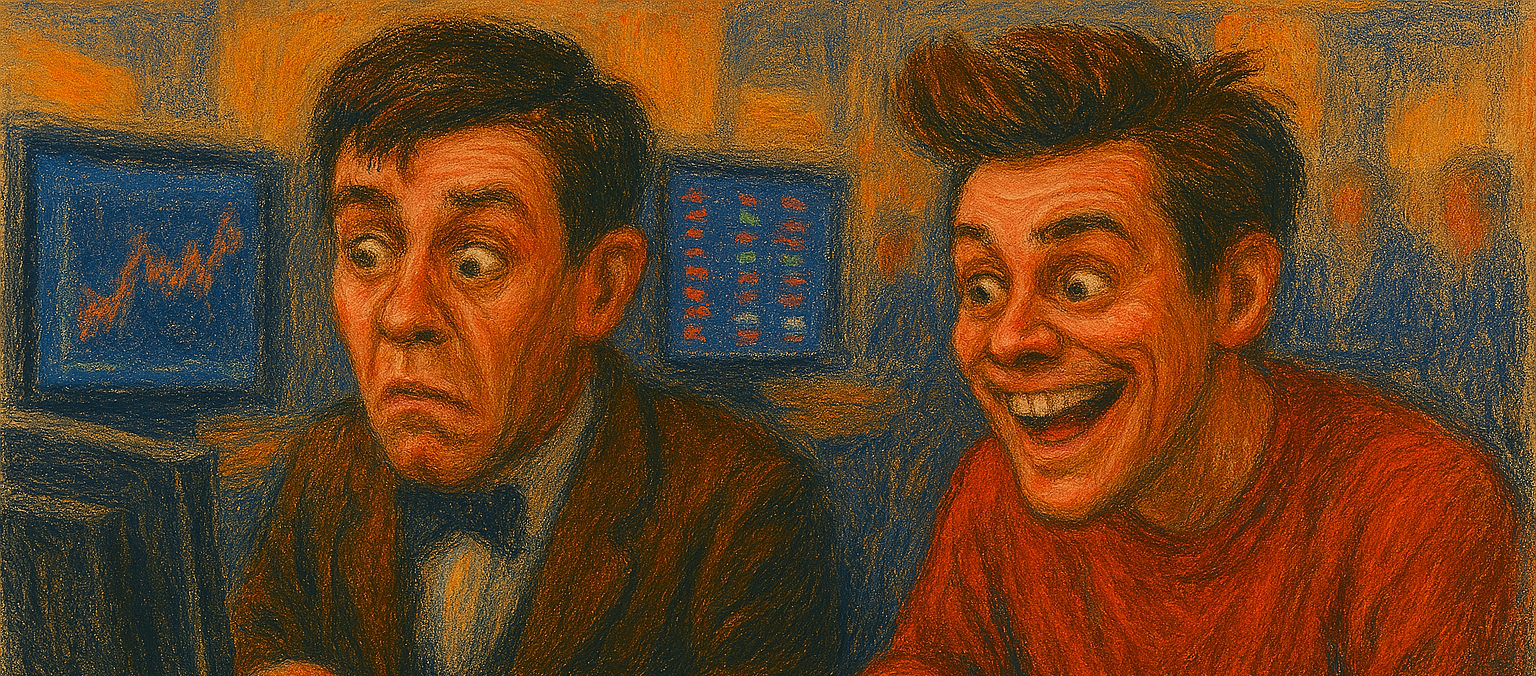
A funny, unhinged Jerry Lewis and a wild‑eyed Jim Carrey on the stock market would trade with the same manic electricity they brought to the screen — a blend of slapstick chaos, accidental brilliance, and pure improvisational instinct. They wouldn’t just trade; they’d perform the market.
Jerry Lewis
Jerry Lewis would treat every ticker symbol like a vaudeville prop. He’d mash the keyboard with exaggerated panic when a stock dipped two percent, flail his arms when a chart spiked, and narrate every move in that high‑pitched, nervous stammer. His trades would be impulsive but oddly lucky — the kind of luck that comes from stumbling into the right button at the wrong time. He’d chase momentum like it was rolling downhill, tripping over himself, recovering, tripping again, and somehow ending the day green. His strategy would be pure physical comedy: slapstick scalping, pratfall portfolio rotation, and a risk‑management style that involves yelling “LADY!” at the screen whenever volatility hits.
I get paid for what most kids get punished for.
Jerry Lewis
People hate me because I am a multifaceted, talented, wealthy, internationally famous genius.
Jim Carrey
Jim Carrey, on the other hand, would be a human volatility index. He’d morph into characters depending on market conditions — Ace Ventura during a bull run, The Mask during a breakout, and a full‑blown Cable Guy when a trade went against him. His face would contort with every candle on the chart. He’d talk to his positions, interrogate them, mock them, and hype them up like a motivational speaker on espresso. But beneath the madness, he’d have a surprisingly sharp instinct for sentiment — reading crowd psychology the way he reads a room. He’d buy fear with a rubber‑faced grin and sell euphoria with a dramatic hair‑whip exit.
You can fail at what you don’t want, so you might as well take a chance on doing what you love.
Jim Carrey
If I make you laugh, I’m doing my job. If I make you think, I’m doing my job well.
Summary
Together, they’d be a trading desk tornado. Jerry’s klutzy chaos would collide with Jim’s elastic intensity, creating a feedback loop of comedic mayhem. They’d accidentally discover strategies — a mis‑clicked options chain here, a manic short squeeze there — and turn them into running gags that somehow make money. Their workspace would be a battlefield of spilled coffee, flying papers, and exaggerated reactions to every tick. And yet, in the middle of the madness, they’d stumble into real insights: timing, emotion, crowd behavior, and the absurdity of markets themselves.
Their trading style wouldn’t be efficient, rational, or calm — but it would be unforgettable. And in their own chaotic way, they’d prove a truth every trader eventually learns: sometimes the market rewards the brave, sometimes the foolish, and sometimes the beautifully, hilariously unhinged.
In a Tweet
Jerry and Jim would be a trading‑desk tornado — klutzy chaos colliding with elastic intensity, mis‑clicked options and manic squeezes turning into running gags that somehow make money. In the madness they’d find real insight: timing, emotion, crowd behavior, and the beauty of being hilariously unhinged in the market.