A supercycle is a multi‑year, sometimes multi‑decade period where demand for a category of commodities rises so strongly — and stays elevated for so long — that prices trend upward in a sustained, structural way.
And once a wave like that takes hold, it reshapes pricing, investment, and supply chains for years to come.
The Core Ingredients
A true supercycle usually requires three forces aligning:
Massive, Structural Demand Shock
Every major commodity supercycle begins with a structural shift in how the world builds, moves, and powers itself. Urbanization in the 2000s—driven largely by China—set the template: billions of tons of steel, copper, cement, and energy pulled into a single gravitational center.
Today’s electrification and decarbonization wave echoes that same pattern, but with a new cast of critical materials like rare earths, copper, and lithium. Layer on the next industrial revolutions and the technologies that demand massive physical inputs, and you get the same unmistakable signature: a world stepping into a new era that requires more raw materials than the existing supply chain can deliver.
Supply Inelasticity
On the supply side, the story moves even slower. Mines take 7–15 years to move from discovery to production, and capex cycles almost always trail demand by a full economic cycle. Add geopolitical bottlenecks and years of chronic underinvestment, and you get a supply chain that simply can’t flex when the world suddenly needs more metal. These constraints don’t just tighten the market—they hard‑wire scarcity into the system.
When demand surges but supply can’t respond quickly, prices grind upward for years.
Global Capital Rotation
When demand tightens and supply can’t respond, the capital cycle wakes up. Investors begin shifting into commodities, sensing the early shape of a structural trend. Producers follow by reinvesting in projects they ignored during the lean years. Governments step in next—sometimes to subsidize strategic materials, sometimes to restrict them—and infrastructure spending accelerates as nations race to secure their own supply chains. Once these forces align, the feedback loop becomes unmistakable.
What It Looks Like on a Chart
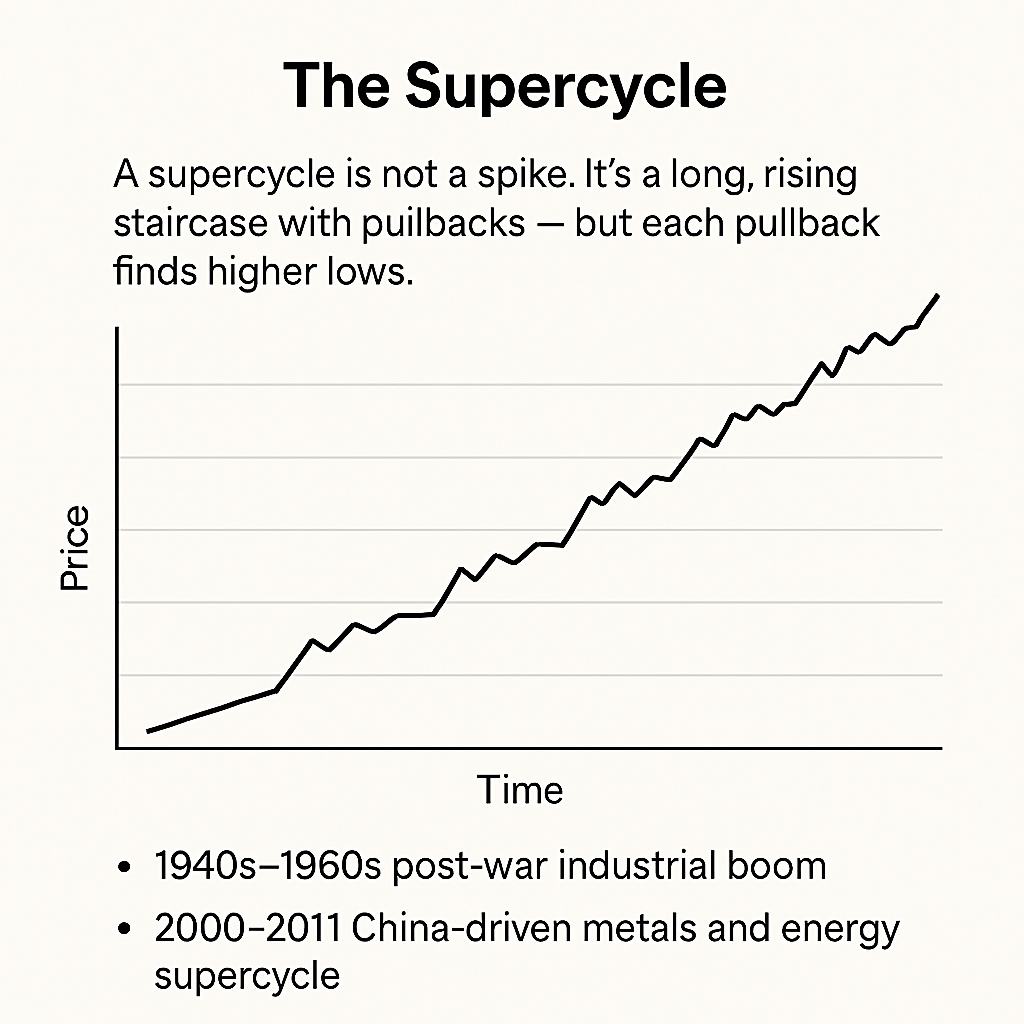
Supercycle’s (Historical)
| Supercycle | Approx. Years | Primary Drivers | Key Notes |
|---|---|---|---|
| Industrial Revolution Supercycle | 1815–1873 | Industrialization in Britain & Europe; steam power; railroads; global trade expansion | Rapid demand for coal, iron, steel; prices rose for decades before the Long Depression ended the cycle |
| Early 20th Century Supercycle | 1899–1939 | Second Industrial Revolution; WWI; early electrification; global rearmament | Strong demand for metals, oil, and industrial inputs; cycle interrupted by the Great Depression |
| Post‑War Reconstruction Supercycle | Mid‑1940s–1960s | Rebuilding Europe & Japan; baby‑boom consumption; early globalization | Massive demand for steel, copper, oil; global rebuilding drove sustained commodity strength (context from historical patterns; not directly cited in search results) |
| Dollar‑Depreciation Supercycle | Mid‑1960s–Late 1970s | Breakdown of Bretton Woods; U.S. dollar decline; inflation; oil shocks | Broad‑based commodity surge driven by currency weakness and inflationary pressure |
| China Urbanization Supercycle | Mid‑1990s–2011 | China’s industrialization, urbanization, manufacturing boom | Huge demand for copper, steel, oil; “you can’t modernize a billion‑person nation without massive raw materials” |
| Potential Emerging Supercycle | 2021–? | Electrification, decarbonization, AI infrastructure, defense spending, reshoring | Early signs noted by CME economists; not yet confirmed as a full supercycle |
Sources
- CME Group analysis of past supercycles
- TradingView historical overview of 19th & early 20th century supercycles
Why People Talk About a New One
People are talking about a new Supercycle because the same ingredients that powered past ones are lining up again. Electrification, AI infrastructure, defense spending, and supply‑chain reshoring all demand enormous volumes of copper, rare earths, lithium, nickel, graphite, and other critical materials. At the same time, supply remains constrained, slow, and underbuilt. When structural demand rises while supply stays rigid, the conversation inevitably shifts toward the possibility of another long, grinding commodity uptrend.
And supply is constrained almost everywhere.
Trading Strategies for a Supercycle
| Cycle Phase | Market Conditions | Trading Approach | Best Vehicles |
|---|---|---|---|
| Early Phase (Stealth Accumulation) | Demand rising, supply rigid, skepticism high | Accumulate core positions; scale in slowly; use long‑dated options | Low‑cost producers, royalty companies, broad commodity ETFs, LEAPS |
| Mid‑Cycle (Recognition Phase) | Prices trending, capital rotating in, broad participation | Buy pullbacks; add to strength; diversify across strongest commodities | Mid‑cap miners, sector ETFs, futures for trend‑following |
| Late Cycle (Euphoria & Overbuild) | Capex surges, supply expands, volatility rises | Trim winners; rotate defensive; hedge; protect gains | Royalty companies, low‑debt majors, collars, spreads |
| Cycle Peak / Exhaustion | Inventories rise, prices stop reacting to bullish news | Reduce exposure; tighten stops; shift to income‑oriented plays | Majors, dividend payers, cash, defensive hedges |
Summary
A Supercycle is a long stretch when structural demand for key commodities rises faster than supply can respond, pushing prices higher for years and reshaping markets, investment, and supply chains. These cycles form when massive demand shocks collide with slow, inelastic supply and a global rotation of capital into commodities. History shows this pattern from the Industrial Revolution to China’s 2000s boom, and many see the same setup emerging today as electrification, AI infrastructure, defense spending, and reshoring meet constrained supply. For traders, the edge comes from recognizing the cycle’s phases—accumulating early, riding mid‑cycle strength, and managing late‑cycle volatility as the trend matures.
In a Tweet
A Supercycle forms when massive structural demand collides with slow, inelastic supply—pushing commodities into long, grinding uptrends. Electrification, AI, defense, and reshoring are lighting the fuse again. Smart traders position early, ride the middle, and protect the peak.