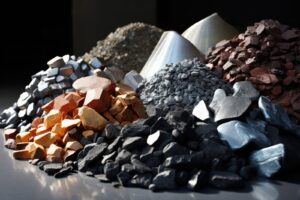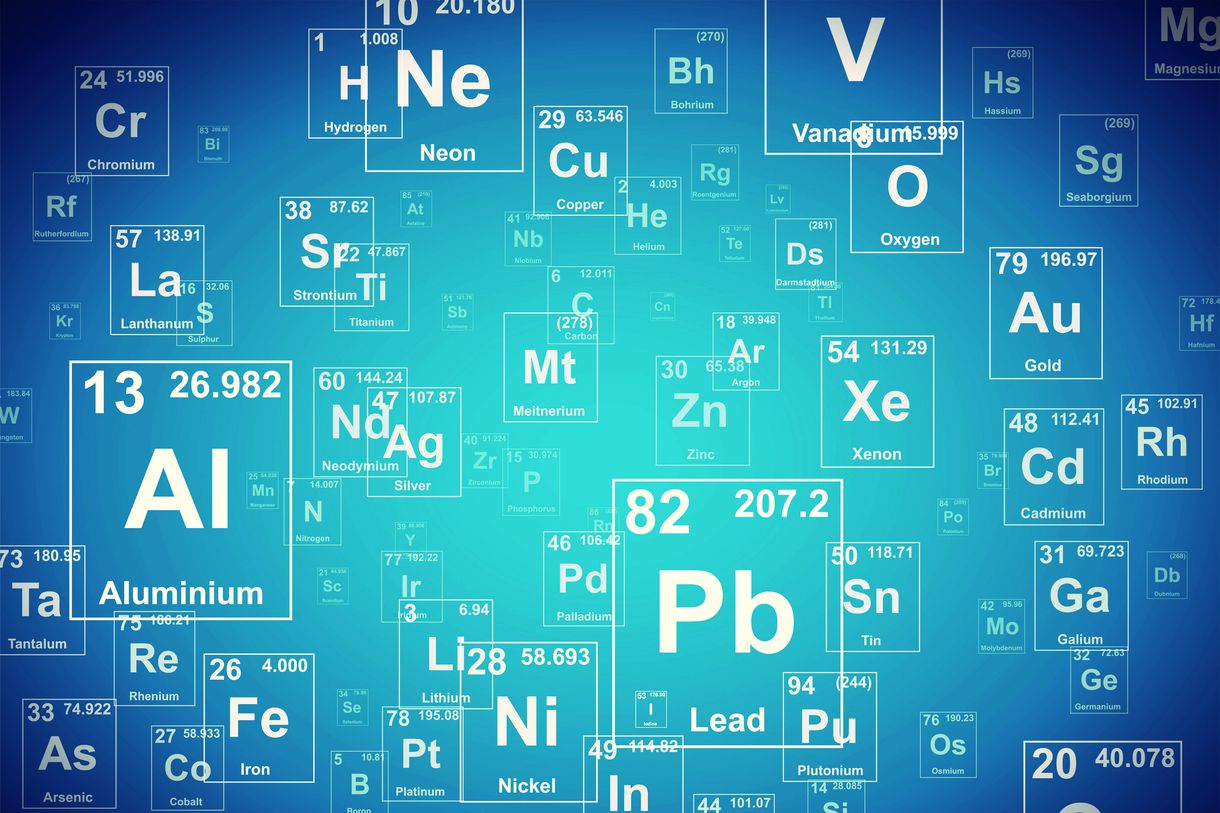
Rare earths are a specific group of 17 metallic elements (the 15 lanthanides plus scandium and yttrium), while critical metals are a broader category of minerals deemed essential to economic and national security but vulnerable to supply chain disruption. All rare earths are considered critical minerals, but not all critical minerals are rare earths.
Rare Earth Elements (REEs)
Rare earth elements include 17 metals such as the lanthanides, scandium, and yttrium. They carry unique magnetic, optical, and catalytic traits that drive applications in permanent magnets for EV motors and wind turbines, electronics like smartphones, displays, and fiber optics, and defense systems including guidance, lasers, and radar. Although the Earth’s crust holds them in abundance, their dispersed nature makes extraction complex and costly. China dominates global production and refining, which creates significant supply risk.
Critical Metals / Minerals
Governments such as the U.S. DOE and USGS designate critical metals as vital to the economy and national security because they face vulnerable supply chains. These metals include lithium, cobalt, nickel, graphite, gallium, platinum group metals, titanium, tungsten, vanadium, and rhenium. Industries use them in energy transition technologies like batteries, solar, and wind, in aerospace and defense through superalloys and jet engines, and in electronics and communications. Policymakers adjust the list dynamically, adding or removing minerals as technology needs and geopolitical risks evolve.
| Aspect | Rare Earths | Critical Metals |
|---|---|---|
| Scope | 17 specific elements | Broad category (50+ minerals) |
| Definition | Scientific (lanthanides + Sc + Y) | Strategic/economic (supply risk + importance) |
| Overlap | All rare earths are critical | Not all critical metals are rare earths |
| Applications | Magnets, optics, electronics, defense | Batteries, aerospace, clean energy, industrial alloys |
| Supply Risk | China dominates refining | China also dominates many critical metals (e.g., graphite, gallium) |
Takeaway
Rare earths form a subset of critical metals, while critical metals cover a broader strategic category. Both play essential roles in clean energy, advanced electronics, and defense. Chemistry defines rare earths, but strategic importance and supply risk define critical metals.
Rare earths as the “hidden backbone” of tech, critical metals as the “strategic lifeblood” of resilience.
Key Companies Overlapping Critical Metals & Rare Earths
| Company | Ticker(s) | Focus | Overlap |
|---|---|---|---|
| USA Rare Earth (USAR) | NASDAQ: USAR | Developing Round Top deposit (TX) with rare earths + gallium, beryllium, lithium; building NdFeB magnet plant in Oklahoma | Rare earths + critical minerals (gallium, lithium, beryllium) |
| MP Materials | NYSE: MP | Mountain Pass mine (CA); U.S. rare earths + magnet production | Rare earths + strategic metals supply |
| Energy Fuels Inc. | NYSE: UUUU | Uranium producer expanding into rare earth separation | Uranium (critical) + rare earths |
| Lynas Rare Earths Ltd. | ASX: LYC, OTC: LYSCF | Leading non-Chinese rare earth producer; Texas separation plant with DoD support | Rare earths + critical mineral refining |
| NioCorp Developments Ltd. | NASDAQ: NB | Elk Creek project (niobium, scandium, titanium) | Critical metals + rare earth element scandium |
| IperionX Limited | NASDAQ: IPX | Sustainable titanium + recycling | Titanium (critical) + rare earth adjacency |
| Ucore Rare Metals | TSXV: UCU, OTCQX: UURAF | Rare earth separation tech (RapidSX) | Rare earths + refining innovation |
Strategic Context
- USAR stands out because it bridges rare earths (NdFeB magnets, Round Top deposit) with critical minerals (gallium, lithium, beryllium). Its acquisition of Less Common Metals (UK) in 2025 expanded alloy and metallization capacity.
- MP Materials and Lynas anchor U.S. and allied rare earth supply chains, both backed by government contracts.
- Energy Fuels and NioCorp bridge uranium, niobium, titanium, and scandium — critical metals with rare earth overlap.
- IperionX and Ucore focus on titanium and separation technologies, reinforcing supply chain resilience.
Takeaway
The companies that overlap critical metals and rare earths — including USAR, MP Materials, Energy Fuels, Lynas, NioCorp, IperionX, and Ucore — form the backbone of Western efforts to secure supply chains for clean energy, defense, and advanced electronics. USAR is especially notable as a new entrant building a mine-to-magnet ecosystem in the U.S.
UPDATE
President Trump signed S.1071, the National Defense Authorization Act for Fiscal Year 2026, on Thursday, December 18, 2025
The 2026 NDAA is especially important for rare earths and critical minerals, elevating them from industrial commodities to strategic assets.
Lone Wolf to Alpha: America’s Rare Earth Chase
USAR as the scout wolf, MP as the alpha, Lynas as the allied wolf, and Energy Fuels/NioCorp as the muscle.